Evaluation of First Cycle of Steam Stimulation in NK Heavy Oil Thermal Pilots
Kuwait Oil Company takes pride in its young employees who carry the baton and walk in the footsteps of the older generation. This young generation is pioneering in research that seeks to develop new and innovative ways and methods to sustain the economic backbone of Kuwait – the oil industry. This would not have been possible without the support and guidance of KOC’s higher management, who work hard to provide a positive working environment and golden opportunities for the young employees so that they can excel, prosper and show their best potential. Among those young employees is Yaqoub Al-Ali, Reservoir Engineer in Heavy Oil Development (NK) Group.
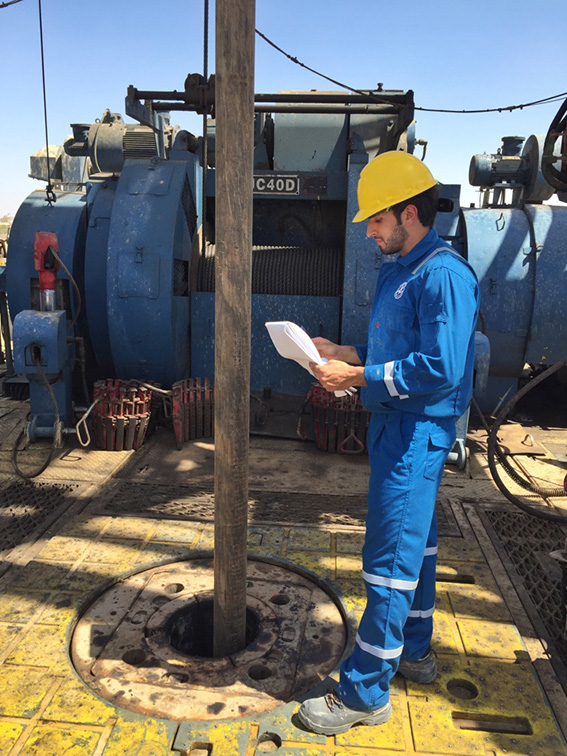
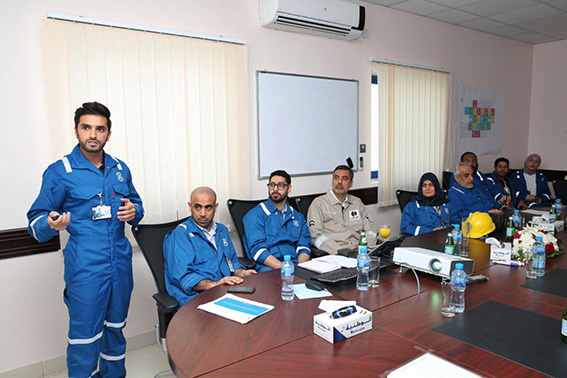
Al-Ali submitted a technical paper where he discussed the Evaluation of the First Cycle of Steam Stimulation in North Kuwait during his participation in the SPE/IATMI Asia Pacific Oil & Gas Conference and Exhibition (APOGCE) conference that was recently held in Jakarta, Indonesia. The study can be found in its entirety at the SPE website under the code: SPE-186182-MS.
The development of viscous oil resources from North Kuwait oil fields is an important strategic project for Kuwait Oil Company (KOC). The project is currently at an early stage and incorporates insights from pilot tests as well as other activities. It is progressing through a phase of development in order to achieve Kuwait’s strategic objectives. Phase 1 of the project aims to increase heavy oil production to 60,000 barrels of oil per day and to sustain it at that level. The second phase will focus on developing opportunities to further increase oil production.
The reservoir consists of two oil-bearing zones, Zone-1 and Zone-2. The two zones are separated by 10-20 feet-thick shale. Each of the Zone-1 and Zone-2 layers are also divided by baffles. Currently there are two new pilot tests which are being conducted in the northern areas of the viscous oil field close to the Heavy Oil Phase I commercial project. One of these pertains to wells spaced at 10 acres apart, and the other has wells spaced at 5 acres apart. These tests are being conducted with the goal of obtaining a better understanding of the reservoir characteristics under cyclic steam stimulation and steam flood operations, which occur at close spacing.
The 10 acre pilot consists of 13 active wells in addition to 9 observation wells, while the 5 acre pilot consists of 13 active wells plus 5 observation wells. In addition to the wells which underwent enhanced oil recovery methods, 4 additional observation wells exist in each of the pilot areas.
The first cyclic steam stimulation on both North Large Scale Thermal Pilots (5 and 10 acre) pilots began in August 2015, and the second cycle commenced in September 2016. During the cyclic steam stimulation phase, all of the wells experienced steam injection and went under production. However, in steam flood phase the central wells will be converted to permanent steam injectors. This began in late 2017 after the second cycle of the cyclic steam stimulation.
The purpose of this study was to explain the operational challenges and the difference in the performance after the first cycle of steam injection in the two pilot tests while utilizing different strategies for well completion. This was done by employing information about the reservoir properties and field surveillance data.
The first cyclic steam stimulation cycle in the wells with 10 acre spacing and the strategy for steaming one zone at a time demonstrated relatively better performance compared to the wells in the 5 acre pilot with a completion strategy for simultaneous steaming. In this instance, more challenges were observed. In the 10 acre pilot, the wells were perforated in the lower zone (Zone 1B) and the 5 acre pilot wells were perforated in both Zones (Zone 1A & Zone 1B).
The insights gained from the first cyclic steam stimulation cycle should help prevent many potential future complications which will likely improve the second cycle and the steam flood.
Production Performance
There is some variation in the production performance of the pilots. Response of the first cycle steam injection for both pilots’ daily steam injected volume as well as the daily produced oil and water volumes profile are presented in the figure below:
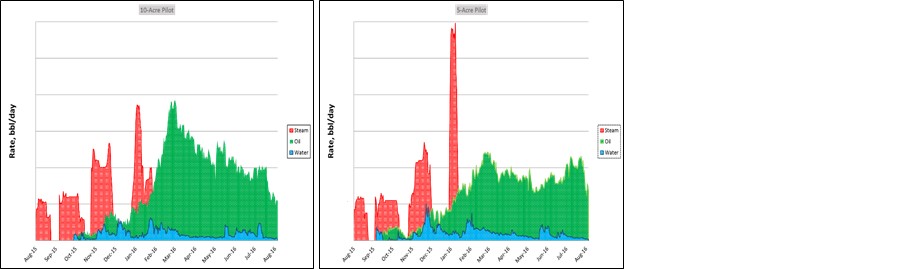
Figure 1: Response of the first cycle steam injection for 10 Acre and 5 Acre Pilots daily steam injected volume and produced oil and water volumes.
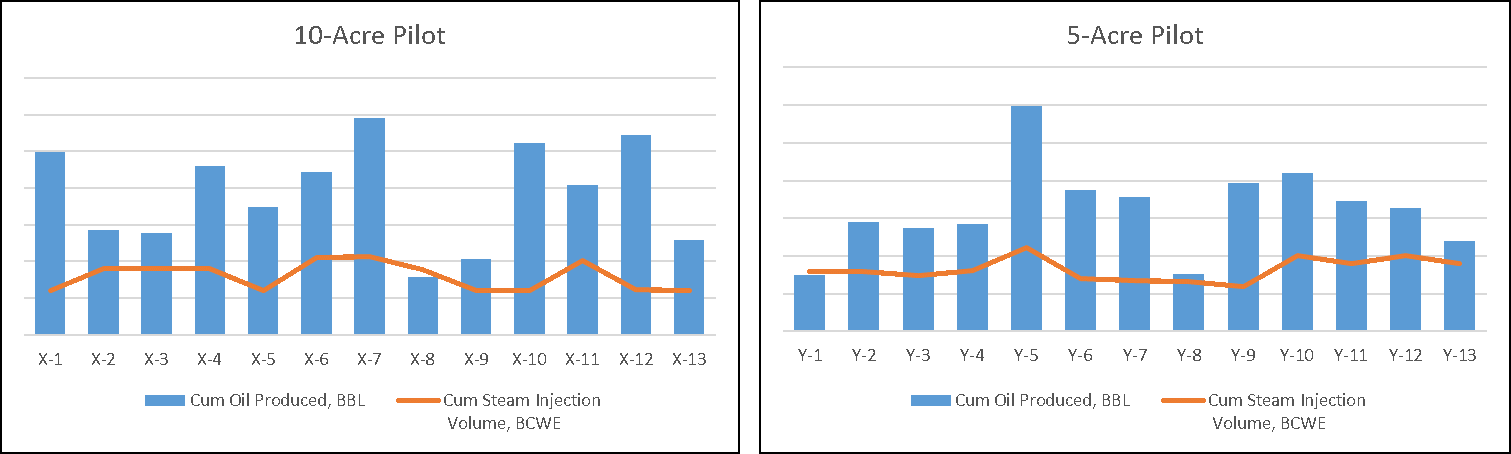
Figure 2: Response of the first cycle cumulative steam injection and cumulative oil production for 10 Acre and 5 Acre Pilots.
The average oil production per well after the first cyclic steam stimulation cycle was higher in the 10 acre wells pilot than the wells in the 5 acre pilot. The steam oil ratio was slightly higher in the 5 acre pilot than the 10 acre pilot.
The amount of gas produced from the 5 acre pilot is about 18% higher than the 10 acre pilot. This is probably due to having perforation intervals close to the gas zone. Gas interference could be one of the reasons why the 5 acre pilot had a production issue, as the tubing was initially set above the perforation. It was observed that the well production improved when lowering the tubing below the perforation. The 5 acre pilot is showing a better recovery factor than the 10 acre is. However, the difference is minimal, only about 1.1%.
The produced water (steam + formation) is less than 30% of the injected steam volume during the first cyclic steam stimulation. In addition, it was confirmed from the produced water salinity and the water cut that the water retention after first steam injection is more than 70%. In addition, the water to oil ratio (WOR) is much less than 0.5 as was observed in the lab experiment.
It was observed that there is rapid heat loss in some of the wells, either immediately after the soaking period or during the hot production. The temperature is set to 120 oF as a base in order to protect the strength of the production well and the tubular and cement behind the casing. It is unclear if this heat is lost due steam slug volume or the soaking period. The range for the slug volumes in these wells is 6,105 to 11,508 barrels of cold water equivalent (BCWE) and the range for the soak period in these wells is 9 to 50. Thus, the wellhead temperature gauges need to be reviewed soon and calibrated whenever it should be required.
About the Conference
The current unpredictability of oil prices globally continues to push the industry to leverage on cutting-edge innovations, improve proficiencies and focus on synergistic partnerships to ensure continuous sustainability. In consideration of the current situation, the theme of the SPE/IATMI Asia Pacific Oil & Gas Conference and Exhibition (APOGCE) was “Energy Resilience through Efficiency, Collaboration and Technology.” APOGCE 2017 encapsulated the need for the industry to focus on a sustainable operational blueprint, innovative technological applications and cost-effective measures.
The three-day event offered an opportunity for energy professionals to convene and discuss current technical topics related to the energy industry with subject-matter experts from across the region and beyond. The strong conference program addressed industry challenges, sought solutions and shared new perspectives on critical topics including rejuvenating exploration and development, sustainable marginal and brownfield production, asset integrity management, leveraging LNG for growth, and new development opportunities, through 10 executive plenary, panel and special sessions. In addition to the high-quality technical content of the 35 technical sessions featuring over 400 technical presentations. The program explored and discussed significant regional oil and gas projects through exclusive case studies.