Ever since its establishment, Kuwait Oil Company (KOC) took upon itself a huge responsibility in contributing to the prosperity of Kuwait’s economy. This is done through its different operations that are primarily linked with oil; the backbone of Kuwait’s economy. It is widely believed that such operations might have their impact on the environment, which is something that KOC took into account, and realized that it has a huge responsibility towards the environment. Its achievements in this regard are exemplified by a number of environmental projects to improve and protect the Kuwaiti environment from hazards. These projects were launched as part of a general policy that was professionally and carefully designed to highlight the Kuwaiti environment as a main feature that takes the attention of all departments, and must be protected for the future generations.
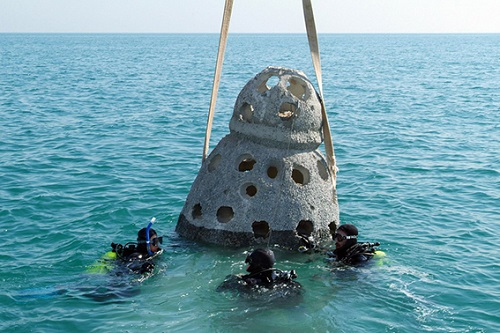
The marine environment rehabilitation project in Kubbar is among the environmental projects that KOC carried out in 2017, and highlights the intensive efforts that the company takes to protect the marine environment in general, and coral reefs in specific, especially given the fact that this is not KOC’s first experience in the Kuwaiti marine environment rehabilitation field; it was preceded by a project to rehabilitate the marine environment in its reservoir in Al-Ahmadi Port, which helped increase demand-driven fish production by over 20%.
Artificial Colonies
The Marine Operations Group at KOC came up with the idea of rehabilitating the marine environment at Kubbar Island, and worked to apply it in cooperation with the Kuwait Institute for Scientific Research (KISR). Planting artificial marine colonies was the project’s first step, as they help protect coral reefs and increase fisheries. These colonies, which belong to KOC, also help in conducting environmental and marine research to collect information that can be used to create a database that plays an important role in achieving the aforementioned goals.
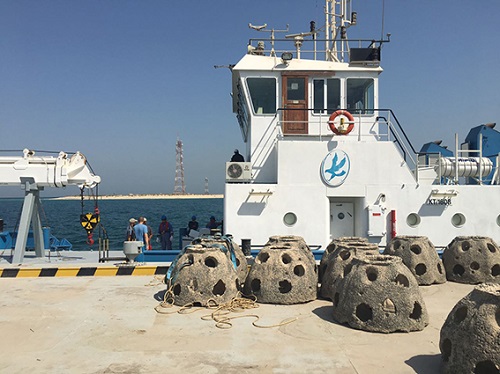
These artificial colonies, which come with hollow concrete balls, were used due to their environmental benefits. Scientific studies indicate that they are considered suitable for reproduction (sexual and asexual), which helps breathe a new life into those reefs and restore the damage they sustained.
Coral Reefs
Coral reefs are given great attention because they are considered important, highly productive and diverse ecosystems, and host a large group of marine species compared to other marine ecosystems. Furthermore, they are considered a suitable environment for the growth, nutrition and reproduction of fish. According to estimations, intact coral reefs produce around 35 tons of fish for every square kilometer a year. Coral reefs also provide protection for coasts by acting as breakwaters that act like desert oases.
Environmental Advantages
Artificial reefs are built on seafloors using processed concrete in suitable depths for colonization of marine species including coral, fish and others, in order to increase coral reefs and restore damage they sustain as a result of natural or human factors.
The Kubbar marine environment rehabilitation project aims at protecting coral and its diversity, while increasing its spread to protect marine life that rely on the coral ecosystems, and especially considering that coral is considered a gemstone as well. The project helps prepare an artificial environment for the growth of coral and fish settlement around it.
On the other hand, the project also creates a unique touristic attraction for divers and seagoers who can enjoy the scene of marine biodiversity that the reefs provide, ultimately benefiting the Kuwaiti economy.
Kubbar Island
Kubbar Island was the first step of the project which the Marine Operations Group at KOC plans to expand to cover other Kuwaiti islands in order to fulfill the company’s environmental strategy, which includes making Kuwaiti islands a suitable environment for marine and touristic activities.
Kubbar was not selected as the first station for the project by coincidence; it was chosen because it is the closest Kuwaiti island to KOC’s marine operations, and witnesses the highest touristic activity among Kuwaiti islands. The large number of boats in the area negatively affects coral reefs in specific and the marine environment in general, which played a role in the decision to choose it as the first island to undergo rehabilitation.
Project Steps
KOC launched the project in cooperation with KISR by examining the area surrounding the island in order to identify the locations best suitable for building artificial reefs. After a complete survey for the island to identify the most feasible locations, a decision was made to build more than six concrete colonies that belong to KOC.
The second step followed; in which boats equipped with cranes that have a lifting capacity of 25 tons were used to carry heavy equipment, including the colonies, from KOC piers to the predetermined work sites. The building process lasted for five days, during which the team which consisted of five divers exerted great efforts to finish the job successfully.
Mooring buoys
The Marine Operations Group at KOC plans to increase the number of mooring buoys in the island in the future. Mooring buoys are environment friendly methods that help facilitate boat and yacht mooring in a safe way that protects the marine wildlife, in addition to their role in helping boats’ moorage and stabilization in cases of high waves. Furthermore, the buoys help protect coral reefs from damage that boats can inflect on coral-rich seabed. The buoys are anchored in locations surrounding coral reefs around the Kuwaiti shores and islands, and are used in boat moorage instead of anchors to protect coral reefs from damage.
Leading Role
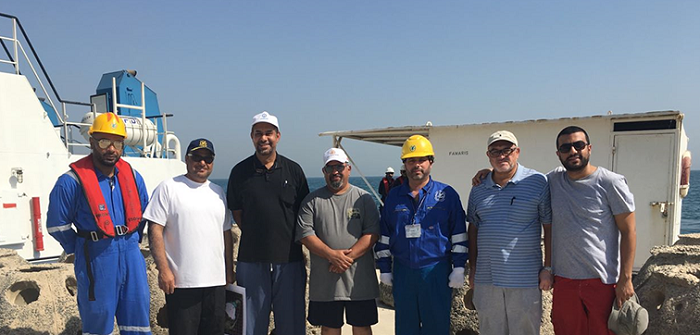
The marine environment rehabilitation project in Kubbar comes as part of efforts which fall under the company’s leading role in protecting the marine environment, said Saud Al-Otaibi, Technical Marine Services Team Leader at KOC. He added that KOC, represented by the Marine Operation Group and its teams, worked continuously to complete the environment project since it started in 2005. Nearly 1,000 units of artificial colonies were built over an area of 45,000 square meters to increase coral reefs and fisheries, Al-Otaibi said, noting that the project aims at rehabilitating damaged coral reefs in the island in cooperation with KISR.